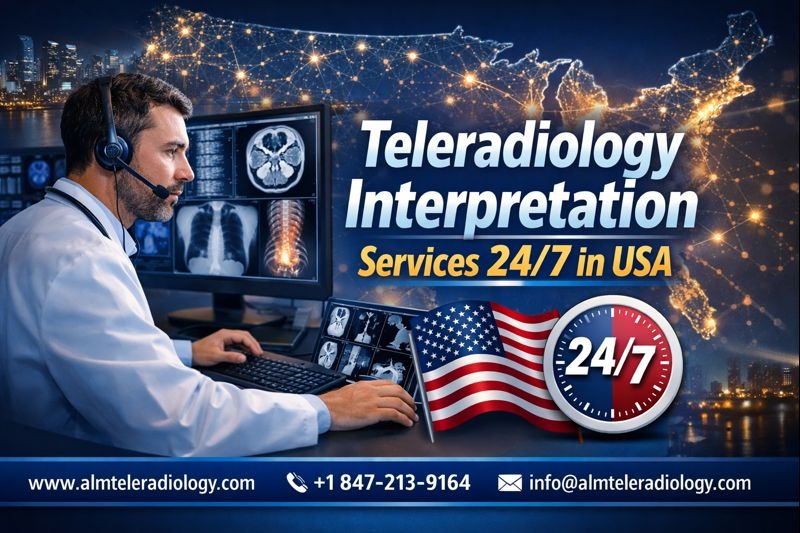
Teleradiology interpretation services 24/7 in USA provide remote, board-certified radiology reads for hospitals, imaging centers, and urgent care clinics around the clock — every day of the year. ALM Teleradiology delivers HIPAA-compliant, STAT-ready interpretation with turnaround times under 30 minutes for emergency reads, subspecialty coverage, seamless PACS integration, and licensed radiologists across all U.S. states including Illinois and Chicago. Contact ALM Teleradiology at +1 847-213-9164 or visit almteleradiology.com.
Table of Contents
- What Are Teleradiology Interpretation Services?
- Why 24/7 Coverage Is No Longer Optional in the USA
- What to Look for in a Teleradiology Interpretation Provider
- Teleradiology Interpretation Services in Chicago, Illinois
- ALM Teleradiology: 25 Years of Expert Interpretation
- Modalities We Read 24/7
- Subspecialty Teleradiology Interpretation Services
- Turnaround Times: What Industry Standards Actually Mean
- HIPAA, HITECH & Compliance in Teleradiology
- How Teleradiology PACS Integration Works
- ALM vs. The Competition: Honest Comparison
- Frequently Asked Questions
- How to Get Started with ALM Teleradiology
1. What Are Teleradiology Interpretation Services? {#what-are}
Teleradiology interpretation services refer to the remote reading and reporting of medical imaging studies — including X-rays, CT scans, MRIs, ultrasounds, PET scans, and mammography — by licensed, board-certified radiologists using secure digital transmission technology.
Instead of waiting for an on-site radiologist to arrive or be called in at 2 a.m., healthcare facilities transmit DICOM image files through a secure network to a remote radiologist, who analyzes the images and delivers a signed, clinical-grade report — often within 30 minutes for urgent cases.
This is not a stopgap solution. According to the American College of Radiology (ACR), teleradiology is now a mainstream standard of care for imaging services in the United States, especially for after-hours, overflow, and subspecialty coverage. You can review the ACR’s position on teleradiology standards at acr.org.
Key Components of a Professional Teleradiology Service:
- Image transmission: Secure DICOM transfer from your PACS or modality to the remote reading station
- Radiologist interpretation: Board-certified physician review and clinical analysis
- Report delivery: Structured radiology report sent directly to your RIS, EMR, or via HL7 interface
- Critical value communication: Verbal or electronic notification for urgent findings
- Quality assurance: Peer review, miss-rate tracking, and ongoing performance monitoring
2. Why 24/7 Coverage Is No Longer Optional in the USA {#why-247}
The United States is facing a well-documented radiologist shortage. According to the Association of American Medical Colleges (AAMC), the physician shortage — including radiologists — is expected to reach critical levels in the coming decade, disproportionately affecting rural areas, community hospitals, and overnight emergency departments. Read more at aamc.org.
For hospital administrators and imaging center directors in cities like Chicago, Illinois, the practical reality is stark:
- Emergency departments run 24 hours a day, but most radiology practices do not
- Trauma centers need stroke protocol and trauma CT reads within minutes, not hours
- Rural and community hospitals cannot afford full-time on-site radiologist staffing
- Locum radiologist costs have skyrocketed, making coverage unsustainable through traditional means
- Patient volumes are rising while radiology residency slots have not kept pace
A facility without reliable, around-the-clock teleradiology interpretation services risks delayed diagnoses, regulatory non-compliance, reduced reimbursement, and — most critically — patient harm.
The economic case is equally clear. Outsourcing overnight and overflow radiology reads to a teleradiology partner converts a fixed overhead cost (a salaried or locum radiologist) into a variable, per-read cost that scales with actual volume. This is particularly valuable for imaging centers in competitive Chicago-area markets where margin pressure is real.
3. What to Look for in a Teleradiology Interpretation Provider {#what-to-look-for}
Before signing with any teleradiology company, the decision-makers at your hospital or imaging facility should evaluate these non-negotiable criteria:
Licensure and Credentialing
Every radiologist reading your studies must hold a current medical license in the state where your facility is located. In Illinois, this means a valid Illinois Medical License. Multi-state licensing is essential for any provider claiming national coverage.
Board Certification
All interpreting physicians should be certified by the American Board of Radiology (ABR) or equivalent. This is not optional — it is a baseline expectation for clinical quality and medicolegal protection.
Turnaround Time Guarantees (TAT)
- STAT/Emergency reads: Under 30 minutes
- Urgent reads: Under 1 hour
- Routine reads: Under 24 hours
Providers who cannot commit to and transparently track these benchmarks should not be considered for acute care coverage.
HIPAA and HITECH Compliance
Image data is Protected Health Information (PHI). Your teleradiology vendor must have documented, auditable compliance with HIPAA and HITECH, including encrypted transmission, secure storage, and Business Associate Agreements (BAAs).
PACS Compatibility
Your teleradiology partner should integrate with your existing PACS infrastructure without requiring a complete technology overhaul. The ability to handle DICOM routing, worklist management, and HL7 report delivery natively is essential.
Subspecialty Depth
General radiology coverage is a minimum — but your facility likely encounters complex cases that require fellowship-trained subspecialists in neuroradiology, musculoskeletal, pediatric radiology, body imaging, or breast imaging.
Quality Assurance Program
Any credible provider operates a documented QA program: peer review, miss-rate monitoring, discrepancy tracking, and outcome reporting. Ask for data — not promises.
4. Teleradiology Interpretation Services in Chicago, Illinois {#chicago}
Chicago is one of the most medically complex urban markets in the United States. The city is home to Level I trauma centers, major academic medical systems, hundreds of independent imaging centers, urgent care clinics, and community hospitals serving ethnically and economically diverse patient populations.
Yet even in a city of nearly 3 million people, radiology coverage gaps are real:
- Night and weekend staffing remains a persistent challenge for community hospitals and freestanding imaging centers
- Overflow management during peak daytime volumes is increasingly outsourced
- Subspecialty access — especially for pediatric, neuroradiology, and musculoskeletal reads — is not uniformly available in-house
- Rural and suburban Illinois facilities in the broader Chicago metro face even more acute shortages
ALM Teleradiology serves healthcare facilities throughout Chicago, Illinois and the greater Midwest, providing 24/7 teleradiology interpretation with radiologists who are licensed in Illinois and familiar with the regulatory expectations of the Illinois Department of Public Health. Facilities in Chicago’s neighborhoods — from the Loop to Pilsen, from Wicker Park to South Shore — can access expert remote reads with the same speed and quality as any major coastal market.
For Chicago-area healthcare administrators interested in learning more about radiology workforce challenges, the Illinois State Medical Society publishes relevant resources at ismanet.org.
5. ALM Teleradiology: 25 Years of Expert Interpretation {#alm-overview}
ALM Teleradiology is a U.S.-based teleradiology company with 25 years of experience delivering accurate, fast, and HIPAA-compliant imaging interpretation services to hospitals, diagnostic centers, urgent care clinics, and physician practices across all 50 states.
Unlike large, impersonal corporate teleradiology conglomerates, ALM Teleradiology operates as a high-touch, relationship-driven partner — combining boutique service quality with enterprise-grade technology.
What makes ALM Teleradiology different:
- American board-certified radiologists trained at prestigious U.S. universities
- Multi-state licensing for seamless coverage in Illinois and every other state
- 365/24/7 availability — no blackout periods, no holidays, no exceptions
- STAT reads under 30 minutes for emergency and critical cases
- Proprietary ALM DICOM Viewer available in cloud, hybrid, and on-site models
- Integrated PACS and RIS solutions designed for seamless workflow adoption
- Subspecialty depth across neuroradiology, MSK, pediatrics, body imaging, and more
- Peer review services to support your accreditation and QA requirements
- Transparent performance reporting so you always know how your reads are performing
- Dedicated support — chat with your radiologist directly through the platform
ALM Teleradiology has been trusted by healthcare administrators, clinic managers, and hospital directors who describe the service as “a trusted extension of our team” — not just another vendor on a contract.
📞 Phone: +1 847-213-9164
🌐 Website: almteleradiology.com
📧 Email: [email protected]
6. Modalities We Read 24/7 {#modalities}
ALM Teleradiology provides expert interpretation services across the full spectrum of diagnostic imaging modalities, available around the clock:
| Modality | Available 24/7 | STAT Reads | Subspecialty Available |
|---|---|---|---|
| X-Ray (Plain Film) | ✅ | ✅ | ✅ |
| CT Scan | ✅ | ✅ | ✅ |
| MRI | ✅ | ✅ | ✅ |
| Ultrasound | ✅ | ✅ | ✅ |
| Mammography | ✅ | ✅ | ✅ |
| PET/CT | ✅ | ✅ | ✅ |
| Nuclear Medicine | ✅ | ✅ | ✅ |
| Fluoroscopy | ✅ | ✅ | ✅ |
| DEXA / Bone Density | ✅ | ✅ | ✅ |
| Echocardiography | ✅ | ✅ | ✅ |
Whether your emergency department needs an urgent trauma CT read at 3 a.m. or your outpatient imaging center needs routine MRI interpretations during a daytime volume surge, ALM Teleradiology delivers the same standard of accuracy and speed — every time.
Explore ALM’s full modality coverage on the All Services page.
7. Subspecialty Teleradiology Interpretation Services {#subspecialties}
General radiology coverage handles most routine imaging needs. But modern healthcare demands access to fellowship-trained subspecialists for complex, high-acuity, or nuanced cases. Misreads in subspecialty imaging — a missed acoustic neuroma, an underappreciated meniscal tear, a subtle lung nodule — carry enormous clinical and legal consequences.
ALM Teleradiology’s subspecialty bench includes:
Neuroradiology
Brain MRI, spine MRI, CT angiography of the head and neck, stroke protocols, intracranial hemorrhage assessment, demyelinating disease evaluation.
Musculoskeletal (MSK) Radiology
Sports injuries, joint MRI, arthritis assessment, bone tumors, MR arthrography, post-surgical evaluation. Particularly relevant for orthopedic practices and sports medicine clinics throughout the Chicago area.
Pediatric Radiology
Specialized interpretation for neonatal, infant, and pediatric imaging where normal variants differ significantly from adult anatomy. Critical for children’s hospitals and pediatric urgent care.
Body Imaging / Abdominal Radiology
Complex CT and MRI of the abdomen and pelvis, liver lesion characterization, renal and adrenal masses, oncologic staging.
Women’s Imaging / Breast Radiology
Screening and diagnostic mammography, breast MRI, breast ultrasound, BIRADS reporting. ACR-compliant workflows.
Thoracic Radiology
Lung nodule management (Lung-RADS protocols), pleural disease, pulmonary embolism, interstitial lung disease, chest CT interpretation.
Cardiac / Cardiovascular Radiology
Cardiac CT, coronary CTA, structural heart disease assessment.
Emergency/Trauma Radiology
Dedicated STAT readers for emergency departments, Level I and Level II trauma centers, stroke centers, and code situations.
Explore the full subspecialty coverage at almteleradiology.com/subspecialties.
8. Turnaround Times: What Industry Standards Actually Mean {#tat}
Turnaround time (TAT) is one of the most frequently cited metrics in teleradiology — and one of the most frequently misrepresented. Here is what the numbers actually mean in clinical practice:
Industry Definitions:
- STAT (Critical/Emergent): Life-threatening or time-sensitive findings. TAT target: < 30 minutes from study completion to signed report delivery.
- Urgent: Clinically significant but not immediately life-threatening. TAT target: < 1 hour.
- Routine: Non-urgent outpatient or scheduled imaging. TAT target: < 24 hours.
ALM Teleradiology TAT Benchmarks:
- STAT reads: Under 30 minutes
- Urgent reads: Under 1 hour
- Routine reads: Under 24 hours
What to watch for with competitors:
Some teleradiology providers advertise fast TAT but measure “time from assignment to report” rather than “time from image availability to signed report.” Always clarify what the clock starts and stops on — and ask for monthly TAT reports from your current or prospective provider.
ALM Teleradiology provides transparent performance reporting, so your team can verify actual turnaround performance against agreed benchmarks at any time.
9. HIPAA, HITECH & Compliance in Teleradiology {#compliance}
Patient imaging data is among the most sensitive categories of Protected Health Information (PHI). The regulatory framework governing how teleradiology companies handle this data is robust and unambiguous.
HIPAA Requirements for Teleradiology Vendors:
- A signed Business Associate Agreement (BAA) is legally required before any PHI is transmitted
- All data must be encrypted in transit and at rest (AES-256 minimum)
- Access controls, audit logs, and workforce training must be in place
- Breach notification protocols must be documented
HITECH Act Obligations:
The Health Information Technology for Economic and Clinical Health (HITECH) Act strengthened HIPAA enforcement, increased penalties for violations, and extended compliance obligations to business associates (which includes teleradiology companies).
For further reading on HIPAA compliance requirements for healthcare technology vendors, visit the U.S. Department of Health & Human Services resource page at hhs.gov/hipaa.
ALM Teleradiology Compliance Infrastructure:
- End-to-end encrypted VPN transmission
- HIPAA and HITECH compliant IT architecture
- Fully redundant, disaster-proof infrastructure
- BAA executed with all client facilities
- JCAHO-aligned quality standards
- Patient privacy protections embedded at every workflow stage
Facilities in Illinois are also subject to state-level health information privacy laws. ALM Teleradiology’s compliance team is familiar with both federal and Illinois-specific requirements.
10. How Teleradiology PACS Integration Works {#pacs}
One of the most common concerns healthcare administrators raise when evaluating a new teleradiology vendor is the technology transition. The reality is that modern teleradiology integration is far less disruptive than most expect — when done correctly.
What PACS Integration Involves:
- DICOM routing configuration: Your existing PACS or modality is configured to automatically forward completed studies to ALM Teleradiology’s secure reading environment via encrypted DICOM transfer
- Worklist integration: Radiologists see studies appear on a prioritized worklist sorted by urgency, modality, and facility
- Report delivery: Completed reports are pushed back to your RIS or EMR via HL7 interface, PDF delivery, or direct PACS integration
- Prior study retrieval: Relevant prior imaging is automatically queried and retrieved to support comparison reads
ALM’s PACS and Technology Stack:
ALM Teleradiology offers its own proprietary DICOM Viewer and PACS system, available in three models:
- ALM Viewer Cloud Model — Zero on-site hardware, fully browser-based, ideal for multi-site or startup imaging operations
- ALM Viewer Hybrid Model — Combines on-site local caching with cloud flexibility for performance-sensitive environments
- ALM Viewer On-Site Model — Full local deployment for facilities requiring maximum data control or with limited internet bandwidth
ALM’s PACS solutions can also be deployed independently alongside your existing infrastructure, making it possible to layer ALM’s reading services onto your current setup without replacing any technology you already rely on.
Explore the full product lineup at almteleradiology.com/all-products.
11. ALM Teleradiology vs. The Competition: Honest Comparison {#comparison}
As a healthcare decision-maker, you deserve a transparent view of how teleradiology providers compare. Here is an honest assessment of how ALM Teleradiology stacks up against the key competitors in the U.S. market.
What competitors do well — and where the gaps are:
StatRad is known for its in-house PACS technology and a transparent client portal for TAT tracking. They are FDA 510(k) cleared as a medical device manufacturer, which is notable. However, StatRad primarily operates as a technology-first platform, and their boutique/personal service model is less emphasized. They also do not prominently feature a proprietary DICOM viewer or locum radiologist services. Their pricing structures are less flexible for smaller or rural facilities.
Premier Radiology Services (formerly NationalRad) has strong subspecialty depth and a broad U.S. footprint, particularly in MSK and neuro. Their radiologist profiles are impressive. However, their pricing and onboarding complexity can be a barrier for independent imaging centers and smaller hospitals. They do not offer a proprietary RIS/PACS product ecosystem — facilities must rely on their own technology.
Vesta Teleradiology positions itself on AI-driven prioritization and cloud workflows. Speed and technology integration are their strengths. However, they offer limited transparency on their radiologist credentials publicly, and they do not appear to offer locum radiologist placement, second opinion, or peer review services as standalone offerings.
ALM Teleradiology’s Competitive Advantages:
| Feature | ALM Teleradiology | StatRad | Premier Radiology | Vesta Rad |
|---|---|---|---|---|
| 25+ Years Experience | ✅ | ✅ | ✅ | ❌ |
| Proprietary PACS/DICOM Viewer | ✅ | ✅ | ❌ | ❌ |
| Proprietary RIS | ✅ | ❌ | ❌ | ❌ |
| Online Locum Radiologist | ✅ | ❌ | ❌ | ❌ |
| Second Opinion Service | ✅ | ❌ | ❌ | ❌ |
| Peer Review Service | ✅ | ✅ | ❌ | ❌ |
| STAT TAT < 30 min | ✅ | ✅ | ✅ | ✅ |
| Illinois/Chicago Licensed | ✅ | ✅ | ✅ | Unknown |
| All-in-One Platform | ✅ | ❌ | ❌ | ❌ |
| Named Doctor Profiles | ✅ | ✅ | ✅ | ❌ |
| Direct Chat with Radiologist | ✅ | ✅ | ❌ | ❌ |
| Mobile Compatible | ✅ | Unknown | ❌ | ❌ |
ALM Teleradiology’s most significant competitive differentiator is its complete ecosystem approach: interpretation services, PACS technology, RIS, second opinion, peer review, and locum coverage — all under one vendor relationship. For facilities seeking to simplify vendor management while improving coverage quality, this matters significantly.
12. Frequently Asked Questions {#faqs}
What is teleradiology interpretation, exactly?
Teleradiology interpretation is the process by which a licensed, board-certified radiologist remotely reviews medical images (X-rays, CT, MRI, ultrasound, etc.) transmitted from a healthcare facility and produces a signed clinical report. It is functionally identical to an on-site read — the only difference is the radiologist’s physical location.
Is teleradiology interpretation legally valid in the USA?
Yes. Remote radiology reads are fully recognized under U.S. federal law and by state medical boards, provided the interpreting radiologist holds a valid medical license in the state where the patient is being treated and meets facility credentialing requirements. In Illinois, ALM’s radiologists hold current Illinois state licenses.
How fast are reports delivered?
ALM Teleradiology benchmarks STAT reads at under 30 minutes, urgent reads under 1 hour, and routine reads under 24 hours — all measured from the time the study is available on the worklist to signed report delivery.
Does teleradiology work with my existing PACS?
In almost all cases, yes. ALM Teleradiology integrates with virtually all major PACS systems via standard DICOM routing. If you use a specific platform, ALM’s technical team will configure the connection during onboarding. ALM also offers its own proprietary PACS and DICOM viewer if you need a technology upgrade.
How is patient data protected?
All imaging data transmitted through ALM Teleradiology is encrypted end-to-end using AES-256 encryption, stored on HIPAA-compliant infrastructure, and governed by a signed Business Associate Agreement (BAA) with your facility.
Can ALM cover a specific specialty, like pediatric radiology or neuroradiology?
Yes. ALM Teleradiology has fellowship-trained subspecialists in neuroradiology, musculoskeletal, pediatric radiology, body imaging, breast imaging, thoracic radiology, and emergency/trauma radiology available 24/7.
What is the difference between a preliminary and a final read?
A preliminary read (pre-read) is a non-binding interpretation used to guide immediate clinical decision-making, typically provided overnight and superseded by a final read from the facility’s attending radiologist. A final read is a legally binding, signed report that becomes part of the patient’s permanent medical record. ALM Teleradiology provides both, according to your facility’s needs.
Do you provide second opinions?
Yes. ALM Teleradiology offers a dedicated Second Opinion Radiologist service for cases where clinical teams or patients require an independent expert review of a prior interpretation.
How do I get started?
Contact ALM Teleradiology at +1 847-213-9164, email [email protected], or request a demo online. The onboarding process is straightforward, and most facilities are live within days.
13. How to Get Started with ALM Teleradiology {#get-started}
Getting started with ALM Teleradiology’s 24/7 interpretation services involves four simple steps:
Step 1 — Initial Consultation
Contact the ALM Teleradiology team to discuss your facility’s specific needs: volume, modalities, specialties, hours of coverage, and technology environment. This can be done by phone, email, or through the online demo request form.
Step 2 — Proposal and BAA
ALM will provide a customized service agreement and execute a HIPAA-compliant Business Associate Agreement. Pricing is transparent and tailored to your actual volume and coverage needs.
Step 3 — Technical Onboarding
ALM’s technical team configures DICOM routing from your PACS or modality, tests image transmission, and validates report delivery to your RIS or EMR. Most integrations are completed in 24–72 hours.
Step 4 — Go Live
Your facility begins transmitting studies for interpretation. From day one, you have access to 24/7 reads, direct radiologist communication, and performance tracking.
Ready to Upgrade Your Radiology Coverage?
ALM Teleradiology serves hospitals, imaging centers, urgent care clinics, orthopedic practices, and health systems across the United States — including Chicago, Illinois and the greater Midwest.
📞 Call us: +1 847-213-9164
🌐 Website: almteleradiology.com
📧 Email: [email protected]
📋 Request a Demo
Explore More from ALM Teleradiology
- All Teleradiology Services
- Subspecialties
- Online Locum Radiologist
- Second Opinion Radiologist
- Peer Review Services
- ALM DICOM Viewer
- PACS Server
- Radiology Information System (RIS)
- Our Doctors
- About ALM Teleradiology
- FAQs
- Blog
External References & Trusted Sources
- American College of Radiology (ACR) — Teleradiology Standards: acr.org
- U.S. Department of Health & Human Services — HIPAA for Professionals: hhs.gov/hipaa
- Association of American Medical Colleges — Physician Shortage Reports: aamc.org
- The Joint Commission — Accreditation Standards: jointcommission.org
- Illinois State Medical Society: ismanet.org
- Radiological Society of North America (RSNA): rsna.org
- American Board of Radiology (ABR): theabr.org
© 2026 ALM Teleradiology. All rights reserved. Content reviewed and verified by U.S. board-certified radiologists. This article is for informational purposes for healthcare professionals and facility administrators and does not constitute medical advice.
Recent Posts
-
 PET/CT Reporting Services in Florida — The Complete 2026 Guide for Hospitals & Imaging Centers
17-Apr-2026
PET/CT Reporting Services in Florida — The Complete 2026 Guide for Hospitals & Imaging Centers
17-Apr-2026
-
 Teleradiology Services Texas USA — ALM Teleradiology 24/7 Expert Reads for Hospitals & Imaging Centers
09-Apr-2026
Teleradiology Services Texas USA — ALM Teleradiology 24/7 Expert Reads for Hospitals & Imaging Centers
09-Apr-2026
-
 Night Shift Teleradiology California USA: Complete 2026 Guide for Hospitals, Imaging Centers & Urgent Care | ALM Teleradiology
31-Mar-2026
Night Shift Teleradiology California USA: Complete 2026 Guide for Hospitals, Imaging Centers & Urgent Care | ALM Teleradiology
31-Mar-2026
-
 After hours teleradiology california USA – 24/7 Expert Radiology Reporting Services
26-Mar-2026
After hours teleradiology california USA – 24/7 Expert Radiology Reporting Services
26-Mar-2026
-
 Teleradiology Services California USA: The Complete 2026 Guide for Hospitals, Clinics & Imaging Centers
19-Mar-2026
Teleradiology Services California USA: The Complete 2026 Guide for Hospitals, Clinics & Imaging Centers
19-Mar-2026